
About WESys 2025
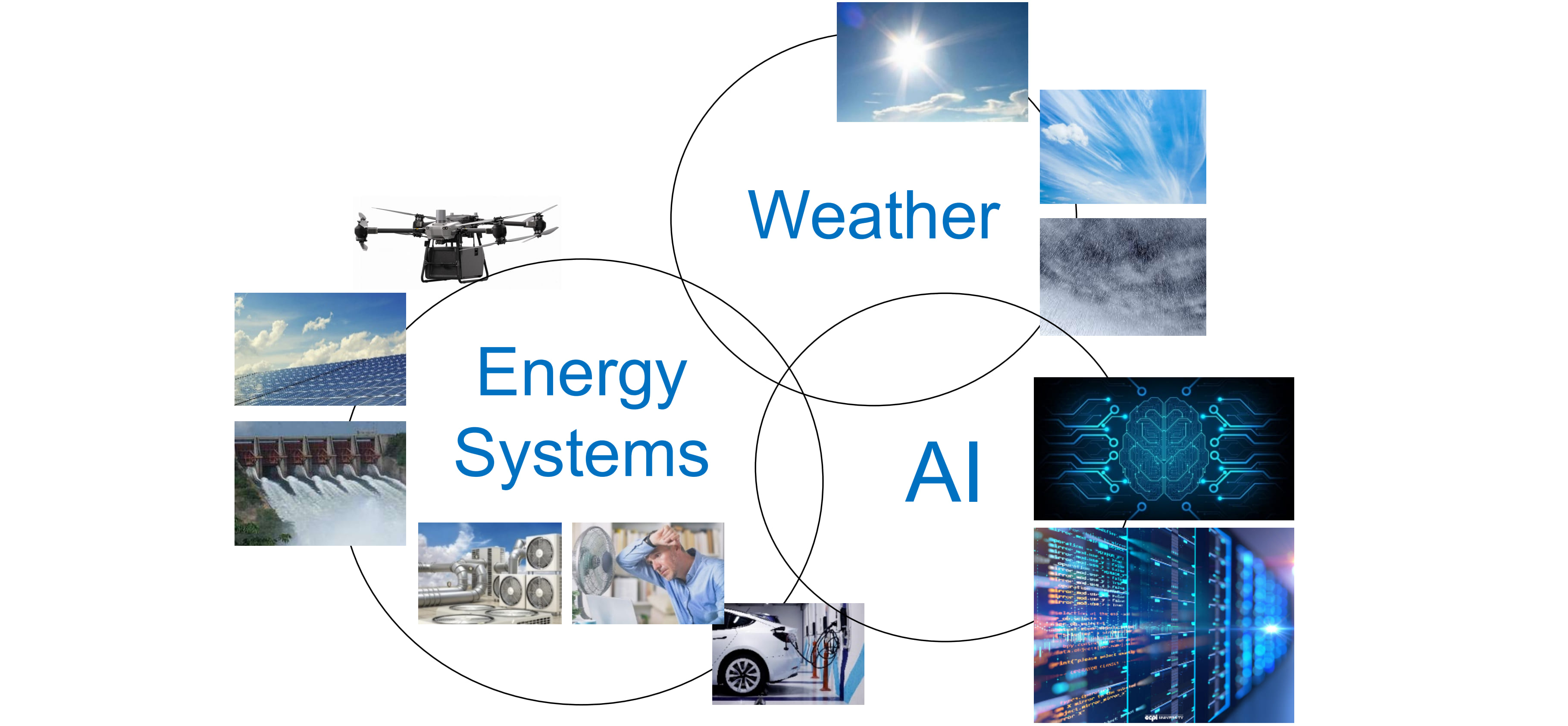
Weather is a critical factor influencing both on energy generation (e.g., photovoltaic systems, hydro energy systems) and energy demand (e.g., low-altitude UAVs, human activities, and electric vehicles). In recent years, We have seen:
(1) New application demands across domains:
- Agricultural energy-water system optimization
- Low-altitude UAV energy load forecasting
- Energy management and charging load forecasting for electric vehicles (EVs)
- Integration and scheduling of renewable energy sources (solar, wind)
- Weather-aware building energy efficiency and HVAC control
- Extreme weather resilience and disaster preparedness for smart grids
- Marine energy utilization and offshore operation safety
(2) Emerging AI/ML Technologies for Weather and Energy Systems:
- Weather Foundation Models
- Graph Neural Networks (GNNs)
- Transformer-based Architectures
- Physics-Informed Neural Networks (PINNs)
- Diffusion Models and Generative AI
- Federated Learning Frameworks
This workshop aims to bring together interdisciplinary scholars from computer science and AI, energy engineering, and climate science to discuss new opportunities in weather and energy systems in the AI era.
Workshop Schedule
| Time | Session | Description |
|---|---|---|
| 14:00 - 14:10 | Opening & Introduction | Dan Wang |
| 14:10 - 14:35 | Invited Talk 1 |
DERConnect Testbed for Building Controls and Testing
Speaker: Jan Kleissl
|
| 14:35 - 15:05 | Discussion Session 1 |
Topic 1: How can weather help energy systems/building systems
(All welcome, we plan to divide participants into groups)

|
| 15:05 - 15:15 | Panel on Discussion Summary | |
| 15:15 - 15:45 | Coffee Break | |
| 15:45 - 16:10 | Invited Talk 2 |
Opportunities and Challenges of Applying Artificial Intelligence in Operational Weather Forecasting
Speaker: Chi Ming SHUN
|
| 16:10 - 16:35 | Invited Talk 3 |
Advancing Renewable Energy Research with Machine Learning in NSF NCAR's Research Applications Laboratory
Speaker: Patrick Hawbecker
|
| 16:35 - 17:05 | Discussion Session 2 | Topic 2: How can AI help in advancing weather and energy
(All welcome, we plan to divide participants into groups)

|
| 17:05 - 17:15 | Panel on Discussion Summary |
Speakers

Jan Kleissl
University of California, San Diego(UCSD)
Jan Kleissl is a Professor in the Department of Mechanical and Aerospace Engineering at the University of California, San Diego and the Director of the Center for Energy Research.
Kleissl received a PhD from the Johns Hopkins University in Environmental Engineering. Kleissl's lab researches novel optimization techniques for DERs in power systems. Kleissl directs the $42M DERConnect distributed flexible load testing facility sponsored by the National Science Foundation.

Chi Ming SHUN
Hong Kong University of Science and Technology(HKUST)
Professor SHUN graduated from the University of Hong Kong in Bachelor of Science, with major in Physics. He joined the Hong Kong Observatory in 1986, specializing in aeronautical meteorology since the 1990s and led the development of the world-first LIDAR Windshear Alerting System.
He was promoted to Director of the Hong Kong Observatory in 2011 and retired in 2020. He also served as President of the Commission for Aeronautical Meteorology of the World Meteorological Organization during 2010-2018. He is now Visiting and Adjunct Professor of HKUST and member of the Council on Carbon Neutrality and Sustainable Development in Hong Kong.

Patrick Hawbecker
National Center for Atmospheric Research (NCAR)
Patrick Hawbecker is a scientist at the National Center for Atmospheric Research working on mesoscale and microscale modeling for onshore and offshore wind energy applications, studying the Chesapeake Bay breeze, and implementing machine learning algorithms into a mesoscale model.
His past research areas include numerical modeling of flow over complex terrain, simulating severe weather events (specifically microbursts) to be used to more accurately determine the lifetime of wind turbines through engineering model analysis, forensic meteorology, mesoscale simulations of severe wind events, and mesoscale to microscale coupling of the WRF model. Past research has involved collaboration with civil engineers for wind turbine statistical analysis.
Call for Posters
We invite researchers, practitioners, and students to submit abstracts for posters that showcase meaningful work at the intersection of AI, weather modeling, and energy systems. The purpose of this submission is : 1) to support younger researchers entering the field by providing a platform to share their ongoing work, and 2) to attract interdisciplinary researchers to present their practical insights and experiences. This is an excellent opportunity to share your cutting-edge research, ongoing projects, or preliminary results with a highly specialized audience.
The posters will be published in Buildsys'25 Proceedings
Topics of Interest include, but are not limited to:
- Integration of weather, energy, and AI-based systems
- AI-powered weather understanding and modeling
- AI-assisted weather data reanalysis
- Weather-enhanced Energy Optimization
- Deployment of integrated weather systems
- Methodologies for the measurement and quantification of AI-powered weather systems
Format: 2 pages in the Buildsys Poster format, including references.
Submission Guidelines
Poster Submissions
- Submission link: All papers must be in Adobe Portable Document Format (PDF) and submitted through the HotCRP platform for this workshop: https://buildsys25-wesys.hotcrp.com/
- Deadline: September 30, 2025 (AOE)
- Notification: October 7, 2025 (AOE)
- Camera-ready: October 10, 2025 (AOE)
Call for Discussion Terms
We invite researchers, practitioners, and students to submit abstracts for discussion terms that showcase meaningful work at the intersection of AI, weather modeling, and energy systems. The purpose of this submission is : to share any abstract, research topics, and emerging trends that can catalyze discussion among the workshop attendees and readers. This is an a unique opportunity to present your insights and engage in a cross-disciplinary exchange of ideas with leading scholars from fields including computer science, energy systems, and climate science.
The submissions will be assigned into several small discussion groups with common research topics. This discussion session aims to facilitate more targeted and in-depth exchanges among participants with shared research interests.
Topics of Interest include:
- How can weather help energy systems/building systems
- How can AI help in advancing weather and energy systems
Format: Maximum 300 words abstract.
Submission Guidelines
Discussion Terms Submissions
- Submission link: All abstracts must be submitted through the HotCRP platform for this workshop: https://buildsys25-wesys.hotcrp.com/
- Deadline: November 3 2025 (AOE)
- Notification: November 10, 2025 (AOE)
Organization
Steering Committee
- Keshav Srinivasan University of Cambridge
- Fei Chen Hong Kong University of Science and Technology (HKUST)
- Dan Wang The Hong Kong Polytechnic University (HK PolyU)
Workshop Chairs
Workshop Chair:
Dan Wang(HK PolyU) Email:dan.wang@polyu.edu.hk
Co-Organizing Chairs:
Fang He(HK PolyU) Email:fanhe@polyu.edu.hk
Jiaqi Fan(HK PolyU) Email:jq898.fan@connect.polyu.hk
Registration and Venue
For registration and venue details, visa information, etc, Please visit the BuildSys webpage